
Metal Building Spray Foam Insulation
Metal Building Spray Foam Insulation
Peak Insulation Co. provides metal building spray foam insulation for warehouses, agricultural structures, shops, and industrial facilities throughout Libby and surrounding Lincoln County. Our closed-cell application process addresses condensation control and thermal bridging in steel structures, backed by Montana contractor licensing and documented commercial project experience.
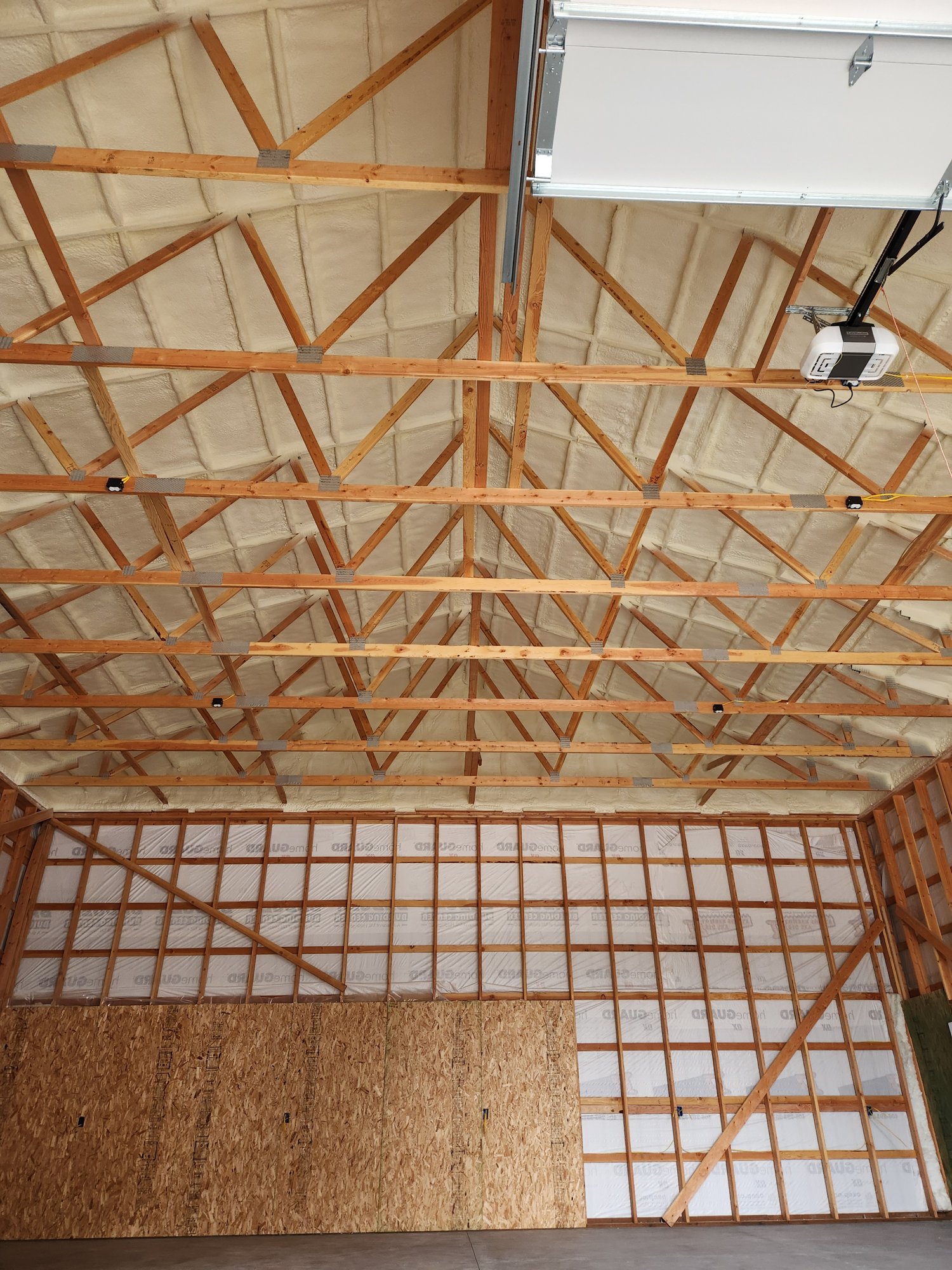
What it is
How spray foam solves the biggest metal building energy problems
Closed-cell foam stops winter drip by keeping the condensing surface inside the insulation, not on your metal panels. The difference shows up first on subzero mornings when uninsulated buildings drip and insulated ones stay dry.
Applied at 3 inches, closed-cell foam delivers R-20+ thermal resistance while sealing every panel lap, fastener penetration, and purlin junction that fiberglass cannot reach. At a typical installed cost of $1.30 to $2.90 per board foot, the material adheres directly to galvanized steel, creating a monolithic vapor barrier that keeps the dew point inside the foam layer where condensation cannot form on cold metal surfaces.
Quick facts
- Condensation control: Dew point stays inside the foam layer
- Thermal bridge elimination: Continuous coverage over purlins and girts
- Air leakage reduction: Adheres directly to metal panel surfaces
- Structural contribution: Adds rigidity to thin-gauge steel assemblies
- Compressive strength: Exceeds 30 psi at closed-cell density
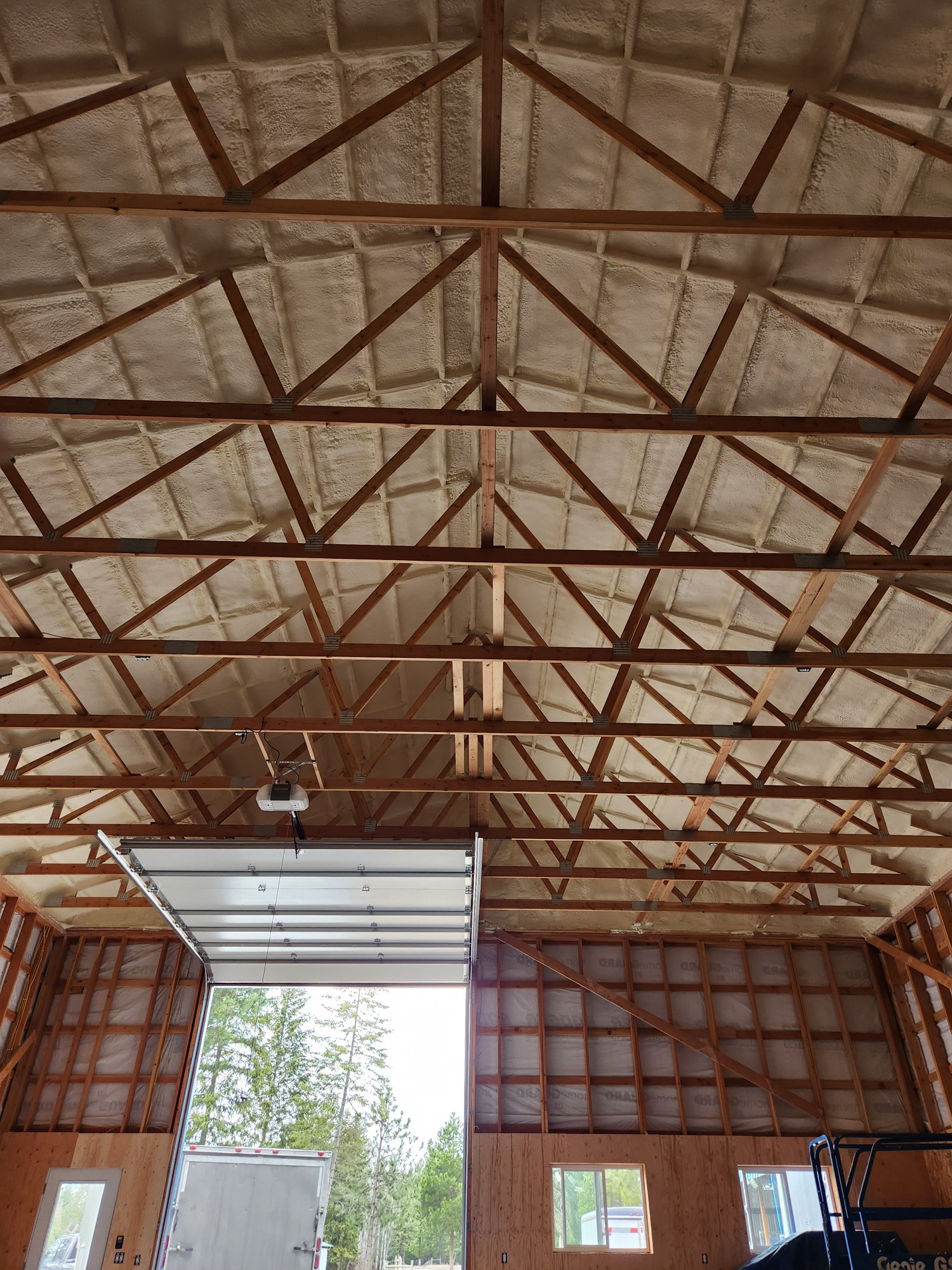
Benefits
What Benefits Does Metal Building Spray Foam Insulation Deliver?
Metal structures sweat. Temperature swings cause condensation to form on interior steel panels, and standard batt insulation traps that moisture instead of stopping it. Closed-cell foam applied directly to the metal seals out humid air before it reaches the cold steel, eliminating the air gap where water vapor condenses. The right install pays you back in lower energy bills, a quieter building, and an envelope that holds up to Montana winters.
Performance gains that compound over time
- Dew point placement: Foam keeps the condensing surface inside the insulation layer, not on the metal panel.
- Panel corrosion prevention: The vapor barrier stops moisture at the source, protecting fasteners and steel from hidden rust.
- Continuous coverage over framing: Foam bonds to every purlin and girt, eliminating the thermal bridges that turn structural members into cold radiators.
- Adds racking strength: Closed-cell foam contributes rigidity to thin-gauge steel that flexes under wind load or thermal expansion.
- Substrate adhesion tested at 15 to 30 psi: Bond outlasts the building envelope itself, provided the metal was clean and above 40 degrees during application.
Hidden moisture risks
The hidden moisture risks that standard insulation misses in metal structures
If you have ever walked into a shop on a January morning and seen water dripping from the ceiling onto equipment, you already know what happens when warm air meets cold steel. That condensation does not announce itself until rust appears, panels corrode, or inventory gets damaged.
This fails quietly over multiple seasons. The panels look fine from outside while moisture works between layers, and by the time rust blooms through the paint, the substrate damage is already structural. Fiberglass allows air movement. Closed-cell foam at $1.30 to $2.90 per board foot stops it cold.
- Panel seams and fasteners: Water vapor migrates through gaps around screws
- Roof-to-wall transitions: Temperature differentials concentrate at junctions
- Thermal bridging points: Uninsulated framing conducts cold through batts
Why spray foam
Closed-Cell Spray Foam vs. Other Insulation on Metal and Post-Frame Buildings
Peak Insulation Co. installs closed-cell spray polyurethane foam. The other systems below are shown for comparison only, because they are what most shop, warehouse, and pole barn owners weigh it against. Application methods differ, so blown-in is often not a direct substitute on an exposed metal assembly.
| Feature | Closed-Cell Spray Foam | Blown / Loose-Fill Fiberglass | Metal Building Batt / Liner | Rigid Board |
|---|---|---|---|---|
| Typical R-value per inch | About R-6 to R-7 | About R-2.5 to R-3.8 | About R-3 to R-4 | About R-5 to R-6.5 |
| Air sealing in one step | Yes, when sprayed onto prepared substrates | No | No | Only where seams are sealed or taped |
| Adheres directly to metal panels and purlins | Yes, on clean and dry panels at suitable temperatures | No, needs a cavity or containment | Draped, compressed at purlins | Mechanically fastened |
| Condensation risk on metal | Reduces the risk by keeping humid interior air off the cold panel when the assembly is designed correctly | Little help; humid air can still reach the panel | Compression and gaps at purlins often leave cold spots | Depends heavily on seam and edge detailing |
| Fits complex framing and penetrations | Expands into ribs, girts, and around penetrations | Poor fit on exposed assemblies | Gaps around obstructions | Extensive cutting and fitting |
| Effect on thermal bridging at purlins and girts | Continuous coverage over framing reduces bridging | Limited | Compressed at framing, so bridging remains | Good when installed as continuous insulation |
| Fire requirements | Requires an approved thermal or ignition barrier per the applicable code path | Varies by product | Facing rating varies | Requires a thermal barrier |
| Best-fit situations | Shops, pole barns, warehouses, and metal roofs where air leakage or panel condensation is the real problem | Flat ceilings above a finished lid | Budget new metal buildings with simple geometry | Continuous insulation layers in designed wall assemblies |
| Key limitation | Higher up-front cost and requires substrate prep, suitable temperatures, and a code-compliant covering | Not an air barrier and not practical on exposed metal | Sags, compresses, and leaves gaps over time | Labor intensive and only as good as the seam detailing |
Typical R-value per inch
- Closed-Cell Spray Foam
- About R-6 to R-7
- Blown / Loose-Fill Fiberglass
- About R-2.5 to R-3.8
- Metal Building Batt / Liner
- About R-3 to R-4
- Rigid Board
- About R-5 to R-6.5
Air sealing in one step
- Closed-Cell Spray Foam
- Yes, when sprayed onto prepared substrates
- Blown / Loose-Fill Fiberglass
- No
- Metal Building Batt / Liner
- No
- Rigid Board
- Only where seams are sealed or taped
Adheres directly to metal panels and purlins
- Closed-Cell Spray Foam
- Yes, on clean and dry panels at suitable temperatures
- Blown / Loose-Fill Fiberglass
- No, needs a cavity or containment
- Metal Building Batt / Liner
- Draped, compressed at purlins
- Rigid Board
- Mechanically fastened
Condensation risk on metal
- Closed-Cell Spray Foam
- Reduces the risk by keeping humid interior air off the cold panel when the assembly is designed correctly
- Blown / Loose-Fill Fiberglass
- Little help; humid air can still reach the panel
- Metal Building Batt / Liner
- Compression and gaps at purlins often leave cold spots
- Rigid Board
- Depends heavily on seam and edge detailing
Fits complex framing and penetrations
- Closed-Cell Spray Foam
- Expands into ribs, girts, and around penetrations
- Blown / Loose-Fill Fiberglass
- Poor fit on exposed assemblies
- Metal Building Batt / Liner
- Gaps around obstructions
- Rigid Board
- Extensive cutting and fitting
Effect on thermal bridging at purlins and girts
- Closed-Cell Spray Foam
- Continuous coverage over framing reduces bridging
- Blown / Loose-Fill Fiberglass
- Limited
- Metal Building Batt / Liner
- Compressed at framing, so bridging remains
- Rigid Board
- Good when installed as continuous insulation
Fire requirements
- Closed-Cell Spray Foam
- Requires an approved thermal or ignition barrier per the applicable code path
- Blown / Loose-Fill Fiberglass
- Varies by product
- Metal Building Batt / Liner
- Facing rating varies
- Rigid Board
- Requires a thermal barrier
Best-fit situations
- Closed-Cell Spray Foam
- Shops, pole barns, warehouses, and metal roofs where air leakage or panel condensation is the real problem
- Blown / Loose-Fill Fiberglass
- Flat ceilings above a finished lid
- Metal Building Batt / Liner
- Budget new metal buildings with simple geometry
- Rigid Board
- Continuous insulation layers in designed wall assemblies
Key limitation
- Closed-Cell Spray Foam
- Higher up-front cost and requires substrate prep, suitable temperatures, and a code-compliant covering
- Blown / Loose-Fill Fiberglass
- Not an air barrier and not practical on exposed metal
- Metal Building Batt / Liner
- Sags, compresses, and leaves gaps over time
- Rigid Board
- Labor intensive and only as good as the seam detailing
When is spray foam the better choice?
On metal and post-frame buildings, closed-cell foam is usually the better fit when condensation on the underside of steel panels is the real issue, when purlins and girts create thermal bridging, or when the building needs insulation and an air barrier applied directly to an irregular surface without a separate framed cavity.
When can blow-in still make sense?
Blown or loose-fill products can work in a flat ceiling assembly with a finished deck above a conditioned space, where there is a defined cavity to fill and no exposed metal for moist air to reach. On an open metal skin it is generally not a direct substitute. Peak Insulation Co. installs closed-cell foam only.
Recent work
See the work we put our name on
Service Area
Metal building spray foam across the service area and surrounding neighborhoods
Peak Insulation Co. serves commercial property owners throughout Libby and Eureka, providing closed-cell spray foam insulation directly at warehouses, shops, and agricultural structures. From downtown Libby to Eureka's industrial corridor, the team reaches metal building sites across Lincoln County via Highway 2, Highway 37, and Pipe Creek Road. Installations typically begin within five business days of the initial site assessment, with substrate preparation and foam application scheduled to minimize operational downtime.
Service Area Coverage
- Serving Libby, Eureka, and surrounding Lincoln County communities
- Accessible via Highway 2, Highway 37, Pipe Creek Road, and Farm to Market Road
- Coverage extends north to Rexford and south to Troy along the Kootenai River valley
- Closed-cell foam applied directly to metal roof decks and wall panels on site
Substrate temperature verification and dew point analysis happen on site before application begins, ensuring adhesion meets ASTM C1029 standards for Montana's cold climate conditions.
FAQ
Metal Building Spray Foam Insulation questions, answered

Get a real number for your project this week.
Tell us about your build, attic, or remodel. We will come out, measure, and send a written quote you can actually plan around.